
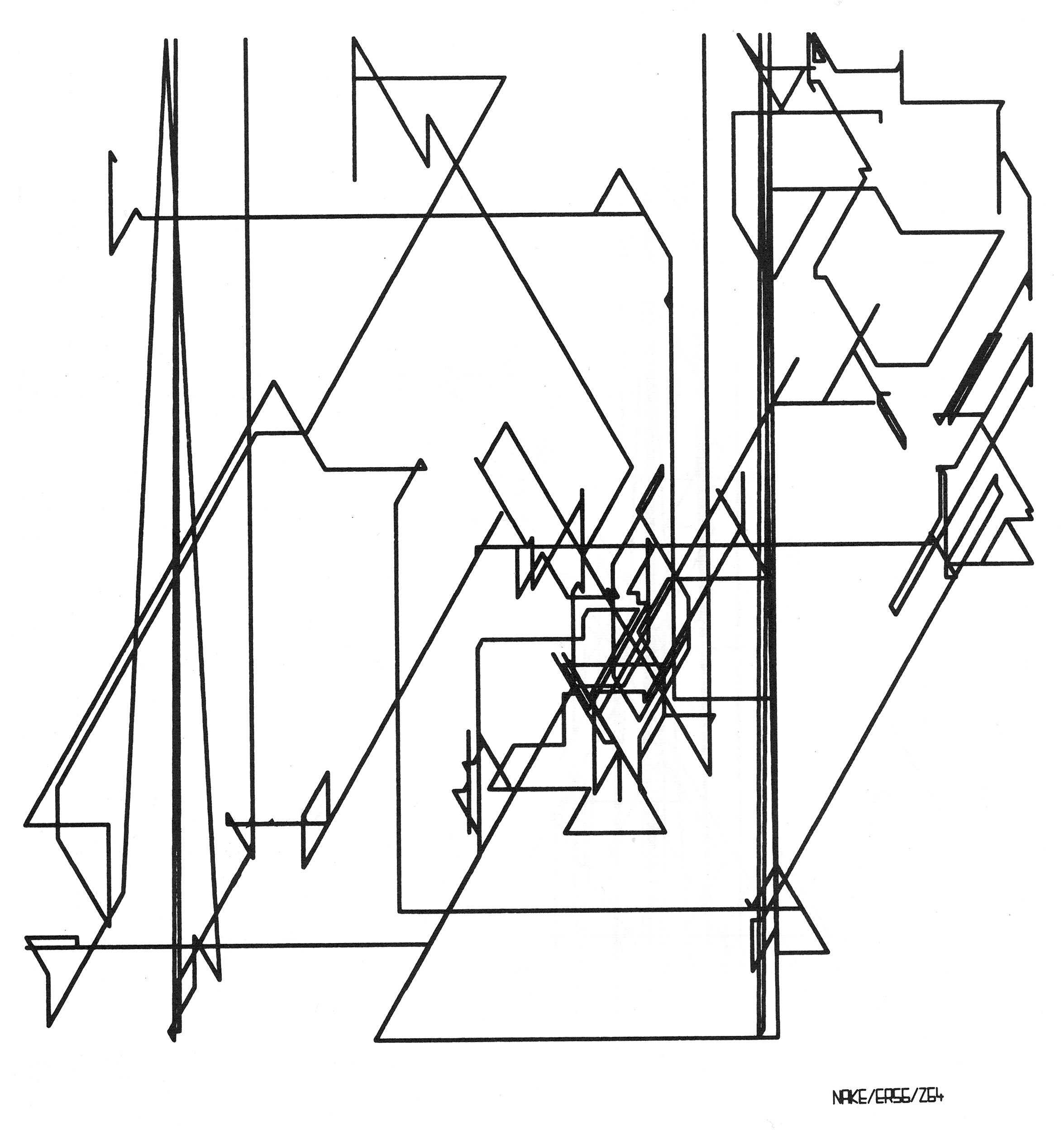
“Think the Image, Don’t Make it!” — Frieder Nake Reflects on 60 Years of Algorithmic Art
With the exhibition “1965 The Beginning — Georg Nees, Frieder Nake” (September 13 to November 1, 2025), DAM Projects Berlin honoured two German pioneers of digital art. In 1965, Georg Nees and Frieder Nake, both trained mathematicians, were among the first to present computer-generated drawings in two historic exhibitions.
During the opening, Frieder Nake joined DAM founder Wolf Lieser in conversation, reflecting on a lifetime of making digital art—from blind programming for early Zuse drawing machines to the operational logic of his latest software piece.
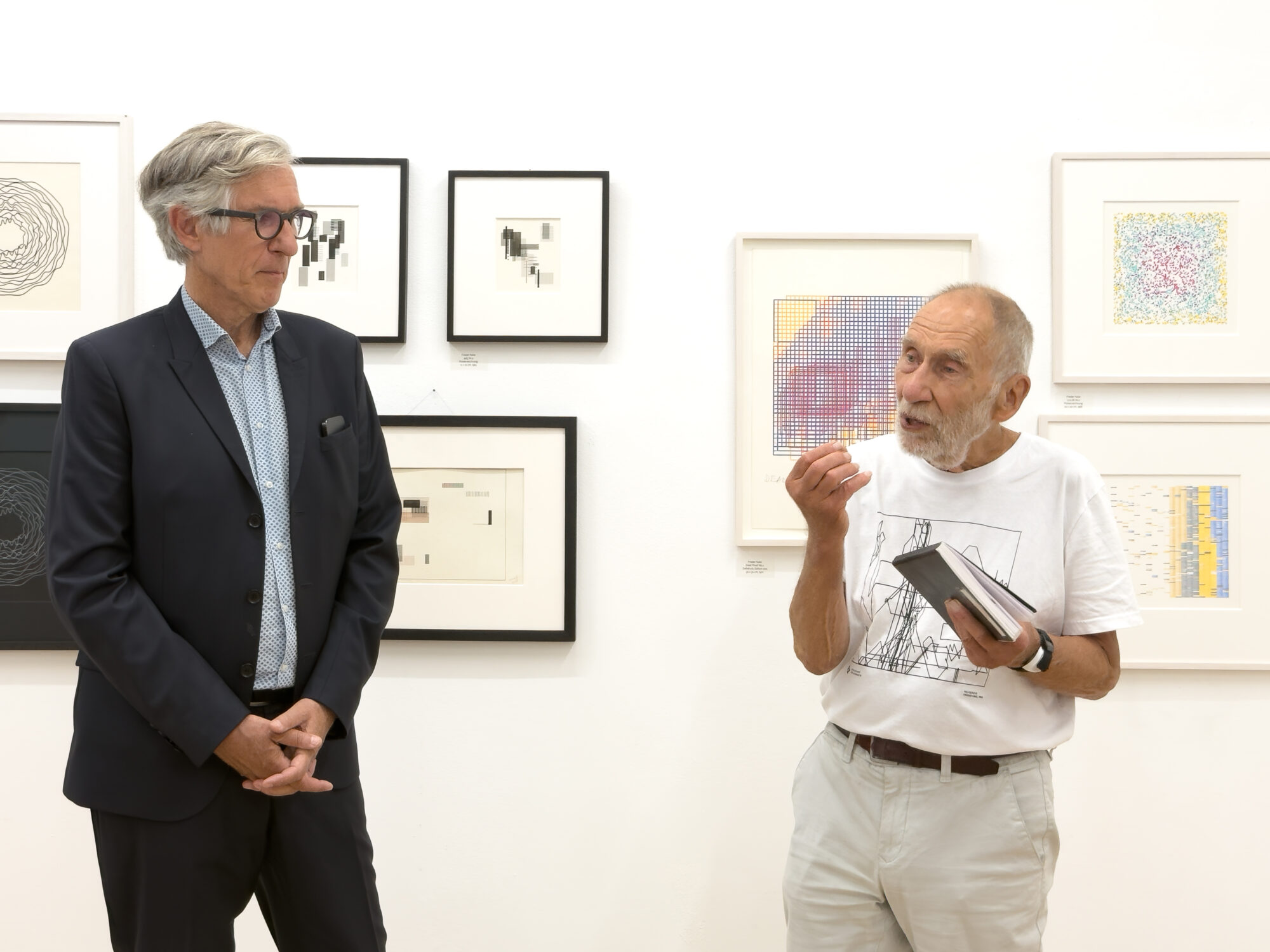
DAM founder Wolf Lieser (left) and Frieder Nake (right) engaged in conversation
Wolf Lieser: Frieder, you began creating computer graphics in 1963. At the time, you were a 24-year-old math student, not a trained artist. How did you get into exploring computers creatively?
Frieder Nake: If I were religious, I’d say it was divine intervention. But I’m an atheist, so this intervention bounced right off me. The real story is that in 1963, while working at the computer center of the University of Stuttgart, its head, Professor Walter Knödel, originally from Vienna, came to me and the following dialogue ensued:
“Mr. Nake, good morning.”
“Good morning.”
“We’re buying a drawing machine.”
“I see.”
“But we’re not getting any software. You write it.”
“Of course.”
The drawing machine that the computer center had ordered was the Graphomat Z64, the last creation of Konrad Zuse, inventor of the computer. We received unit number 9 of the entire series. But because our computer wasn’t a Zuse machine, Professor Walter Knödel had a problem: How to control the Zuse drawing machine with our computer?
The fact that Professor Walter Knödel entrusted this task to a young student who couldn’t possibly know this is remarkable. What I should have said is: “But I don’t even know how to do that. Do you perhaps have a textbook on it? Then I could give you an answer in maybe a month.” This trust the professor had in me, the young student, was empowering. I could only say yes, even though I had no idea. And for the rest of my life, I’ve taken on things I had no idea about.
So I began developing this software. But because we didn’t have a drawing machine yet, I couldn’t test it. So I wrote programs blindly on punched tape and travelled with them to the Zuse headquarters in Bad Hersfeld, hoping they would work.
The Zuse engineers received me with tepid excitement: “What does he want here?” I took out my punched tape and placed it in the tape reader of the drawing machine. The machine started drawing, but after 5 minutes it stopped. Again and again. A huge debacle! Then I had an idea: Wherever tape is punched, confetti-like paper scraps lie on the floor—including here. Since I knew the code perfectly, I collected a few of these scraps and glued them into selected holes in my punched tape. “May I start again?” “Yes, please,” the engineers answered. And lo and behold, it worked.
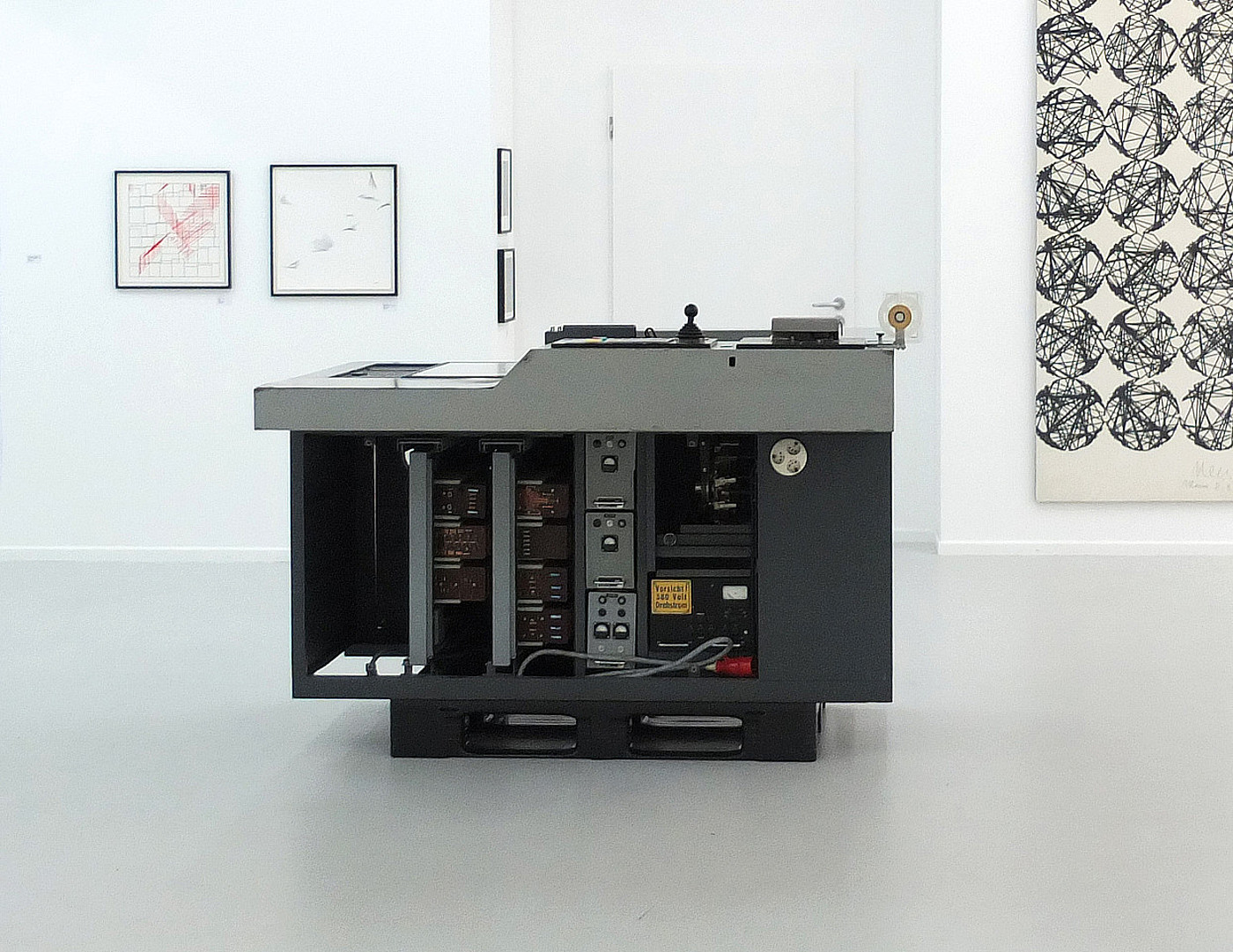
Graphomat Z64, drawing machine, installation view DAM Projects, Berlin
Lieser: What a story! I’ve never heard that one before.
Nake: Yes, defeat and vindication—vindication by pure chance, mind you. Because the little paper scraps had nothing to do with computers. That’s pure materiality. In other words, my program was correct in itself, but I had made a small error. This story changed my life and deeply influenced my thinking in many ways. Materiality and its intellectual interrogation are, for me, as someone who teaches in computer science, the key to understanding what is possible in science and technology. For me, it’s always both: the physicality on one side and our cognitive potential on the other. But yeah, that’s the origin story—but it only gets better.
In February 1965, the first exhibition of computer-generated images took place at Stuttgart’s Technische Hochschule. Their creator was Georg Nees, who taught at the Institute of Philosophy at the University of Stuttgart. A short time later, in April 1965, there was another relevant exhibition at New York’s then-prestigious Howard Wise Gallery that, in my view, is a little overrated. If you look at photos of the exhibition, you’ll see that it was focused on more traditional art. The included, now historic, computer-generated drawings by A. Michael Noll were a sideshow.
So I said to myself: Nake, you have such images too! Even from 1964. So I went to Max Bense, philosopher in Stuttgart, and told him: You know what, I have such images too. Why don’t you visit me at the computer center?
Lieser: It’s worth mentioning that Max Bense was very influential at the time, especially for the pioneers of digital art. Bense, who lectured in Stuttgart, had published several books on information aesthetics under the title “Aesthetica,” which we also revisited in a eponymous DAM exhibition in 2015. You knew him, of course, and attended his lectures, which, as you say, were always well attended, even though no one understood anything.
Nake: I attended Max Bense’s main lecture every semester; it was always on Mondays at 5 p.m. All of Stuttgart’s intellectuals went there. Nobody understood a single word, but everyone was ecstatic. During his lectures, he’d walk back and forth, only stopping in between thoughts. One time, he looked at us sharply and said, “You know what? You can throw away a third of all philosophy, it’s just poetry.” Brilliant!
Lieser: You then approached him about the exhibition?
Nake: Yes, it took place in November 1965—but Bense didn’t come.
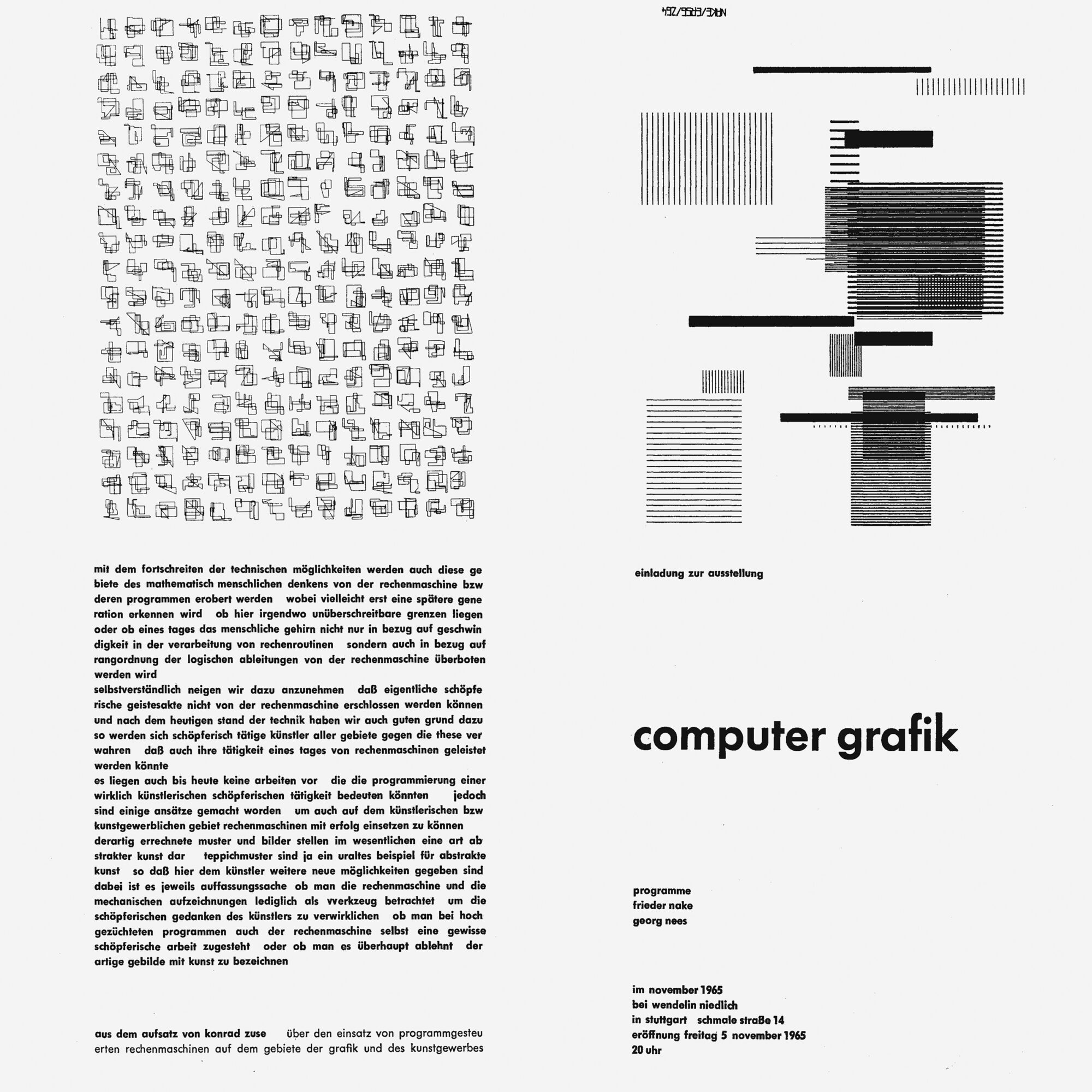
Exhibition invitation: “Computer Grafik”, Frieder Nake, Georg Nees, November 1965, Galerie Niedlich, Stuttgart
Lieser: The exhibition took place in a proper gallery, too! Wendelin Niedlich, the owner, ran a busy exhibition program. And the invitation included a text by Konrad Zuse himself.
Nake: I was a regular at Galerie Niedlich, which was also a bookstore. I went there every Saturday, sat down in a corner, grabbed a book from the shelf, and read it. I’d often get a cup of coffee from Wendi—that’s what we called Wendelin. Wendelin Niedlich: With a name like that, you’ve already won at life.
The exhibition, of which I’m very proud, came about like this: I went to Niedlich and told him that I have images similar to those by Georg Nees and—how arrogant—that mine are better. Niedlich, a funny but also serious person, looked at his calendar: “Yes, here in November would be the next opportunity to exhibit.” That’s how I got to show my works in the third-ever exhibition of computer-generated art. And it changed my life.
Shortly after, in February 1966, I organized an exhibition at the German Computer Center in Darmstadt—a place that had nothing to do with art. It brought together texts, images, and music generated by computers. A major newspaper, the Frankfurter Allgemeine Zeitung, wrote a half-pager about it. It was a mocking article. It included the following anecdote: Nake sits in a café, flicking a dollop of cream off his pants while next door the computer makes his images.
Peter Bauman: Some of the works you exhibited at Niedlich’s became very well known. We mustn’t forget that this was a completely new field in art at the time, an absolute outsider position. Nevertheless, you were able to sell works directly from this exhibition—a sensation for the time! Can you elaborate on that?
Nake: Yes, people asked me, “Can I buy that?” Suddenly, I was confronted with the question of how much money to ask for. I already knew that prices in art have very little to do with the art itself. So I came up with a scheme: For each drawing, I noted how much time it took to be drawn. I should have also included the computing time, but I didn’t because that wasn’t much. Then I had an index that determined the price in D-Marks. People asked me about the minutes, and I told them the price. With this, I also wanted to make a statement about the art market.
Lieser: I remember seeing prices of 50 or 60 D-Marks pencilled on the backs of quite large works that were sold from the exhibition. Can you maybe say something about the aesthetic processes behind the drawings? How did you arrive at the various positions?
Nake: Let me say something about this work, 4.5.65 Nr.3, weisser Kreis, a plotter drawing from 1965. You’ll notice this spike here in the motif. It defines the aesthetics of this image. In the centre of the piece is a circle that is dissolved outward and inward. The math behind the program produces these strange, increasingly pronounced swerves. And then comes this sudden spike. That’s where the math ran into a problem. The interpolation from one point to the next couldn’t be performed as such and had to deviate in order to continue. So the machine could only do its work by producing this spike. This purely mathematically determined compensation defines the entire image. In other words, the machine can be forced to do something aesthetically remarkable entirely through the algorithm. That’s interesting to me!
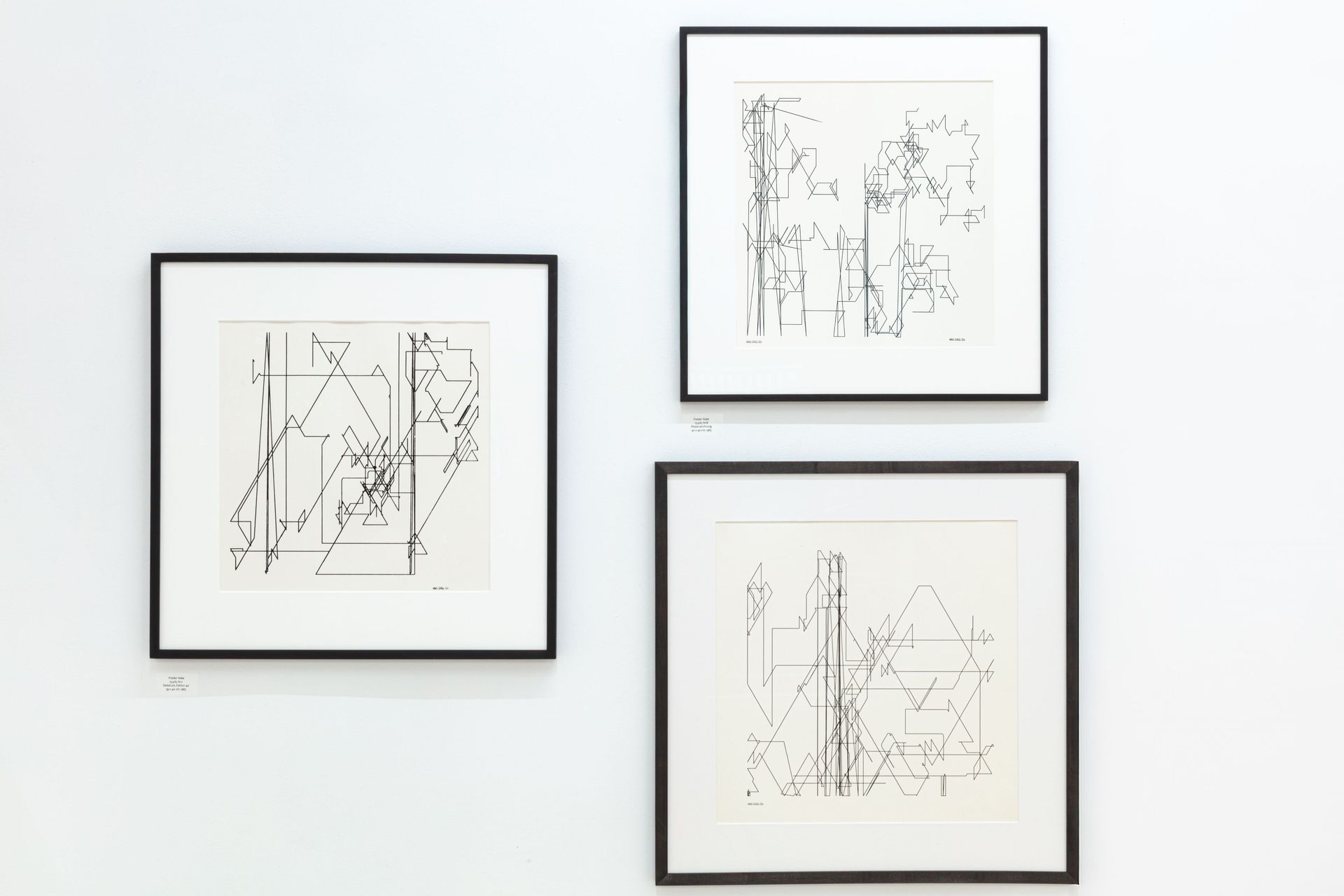
Three of Frieder Nake’s early plotter drawings, including “13.9.65 Nr.7” (left) and “13.9.65 Nr.8” (top, right), installation view “1965 The Beginning – Georg Nees, Frieder Nake” at DAM Projects Berlin
Lieser: We have various other works from this era on display here. Could you also speak about those?
Nake: 13.9.65 Nr.8 is a plotter drawing from 1965 based on a simulated line. For the resulting image, however, this simulation is irrelevant. What do I want to say with this? The person who programs images must think quite differently. I always say: “Think the image, don’t make it.” In computer art, which is better called algorithmic art, the making is delegated to the machine. Everything else remains in the human hand. I firmly believe that a machine will never achieve something comparable to human intuition. Intuition is only possible in living organisms, not in machines, not in an algorithm. As a student, I developed a library of programs to be used by all the engineers at the University of Stuttgart. I had to learn how to write programs correctly so that they run without errors. This taught me that a machine can’t do anything, certainly not by itself. No, wrong again, it can show us errors. But only because we’ve written programs that can detect these errors. Human beings and machines remain strangers, but they become friendlier towards each other over time.
Lieser: Back to the 1960s. Can you speak about the conceptual background of the series “Bundles of straight lines” from 1965?
Nake: In the series, the image format is divided into sub-formats that we don’t see, but which play a major role in creating the image. These bundles of straight lines, which intersect at certain points, are oriented to these fields. The program instructions read as follows: Generate a small straight line randomly, choose a point on it and make this point the carrier of a line. Follow this carrier at random intervals, draw up, down, and change the angle—this produces these strange little bundles. Then go from field to field and decide where the first carrier line is, and draw the subsequent lines attached to it. The visual effect arises from the logic hidden in the program. This is an example of “Think the image, don’t make it.” To think about the events in an image and bring them into a calculable, programmed form. This is new in the history of image-making and aesthetic practice.
Lieser: Your approach is very consistent with Max Bense’s theories of conceptual image-making. An idea pops into your head, you translate it into a programming language, and a series of thematic variations emerges. Do you make aesthetic decisions about the selection of results?
Nake: Yes, always. I threw a lot away. I always judge and select the outputs, definitely.
Lieser: That means the vast majority of this kind of art didn’t survive. Two years ago, I acquired plotter drawings from someone who inherited them. The previous owner had probably purchased them in the 1960s and then put them in a drawer. They were in top condition. The person had probably never looked at them again, died, and had bequeathed them to a friend who only collected art from the first half of the 20th century. So he didn’t know what to do with them and contacted me. It’s safe to say that, here too, a large part of these early works of digital art has probably been lost.

By loading the video, you agree to Vimeo's privacy policy.
Learn more
Lieser: Let’s talk a bit more about the present. I’m very pleased that I was able to persuade Frieder to make a new software work for this exhibition. In recent years, you’ve created several software works. These don’t result in a print or a plotter drawing, but in generative code that is executed by the computer, continuously changes, and produces an aesthetic experience on a computer screen. What can you tell us about this new work, “Colour Grid” (2025)?
Nake: In true algorithmic art, the computer must be present. The image is being created now, in real-time, and it continues to evolve. When everything here in the gallery is switched off tonight and switched on again tomorrow, a different image will emerge—of the same kind, but not identical. The computer, however small it may be, must be present when the image is created. For most of its history, computer-generated art has been dominated by images on paper. I don’t see those necessarily as digital art, but more as outputs in a more conventional tradition. For works like Colour Grid, the presence of the computer is required, because the imagery is a perpetual mode of emerging and disappearing. Here, the concept of computer art, or better, algorithmic art, is justified. The algorithm runs, and the image is being created. And tomorrow it is created differently, and changes continuously throughout the day. The art of working algorithmically is in describing processes to the computer to make images appear.
Visitor: Is it conceivable that in 50 billion years, Colour Grid changes to monochrome?
Nake: Perhaps even in 1000 years. In this work, randomness plays a crucial role. Real randomness, however, is impossible for a computer. Things only appear to be random, but they aren’t.
Lieser: You say randomness plays a major role, but also, in actuality, randomness is impossible. How is randomness generated on a computer?
Nake: Through formulas. There are formulas for this type of randomness, according to which sequences of numbers are generated that appear random to us. But they are calculated and thus not random. This is a strange property of mathematically defined randomness. It’s sets of numbers that are thrown into a pot. How they tumble in there is beyond our control if we don’t know the formulas according to which these numbers have been calculated. But the programmer knows them. In every programming language, there is a “random” function for random values. But since it’s a computable function, it cannot be random, because otherwise it couldn’t be calculated. It will only behave according to probabilities. I think computer scientists should stop talking about randomness altogether!
Lieser: So we’ve clarified that, too. Anything you’d like to say in closing?
Nake: May this: Today, you all have a computer in your pocket, called a smartphone, which contains much more computing power than the computers behind the images in this exhibition. The algorithmic revolution is also a cultural revolution—the deep penetration of algorithms into all aspects of human life. We, who are primarily interested in the computer’s artistic potential, should become a little more aware of this. My images, some of which are now 60 years old, may be somewhat conciliatory towards the algorithm because they’re art. But we should all maintain a critical attitude and draw boundaries. My students complain, for example, that they can’t reach me on a smartphone. It’s true, they can’t and will never be able to. I refuse. It’s my boundary, and I want to be allowed to maintain it. But I belong to a dying generation. Here, where are the two children in the audience? The future belongs to you! Whatever that is.
Lieser: Frieder, thank you very much.
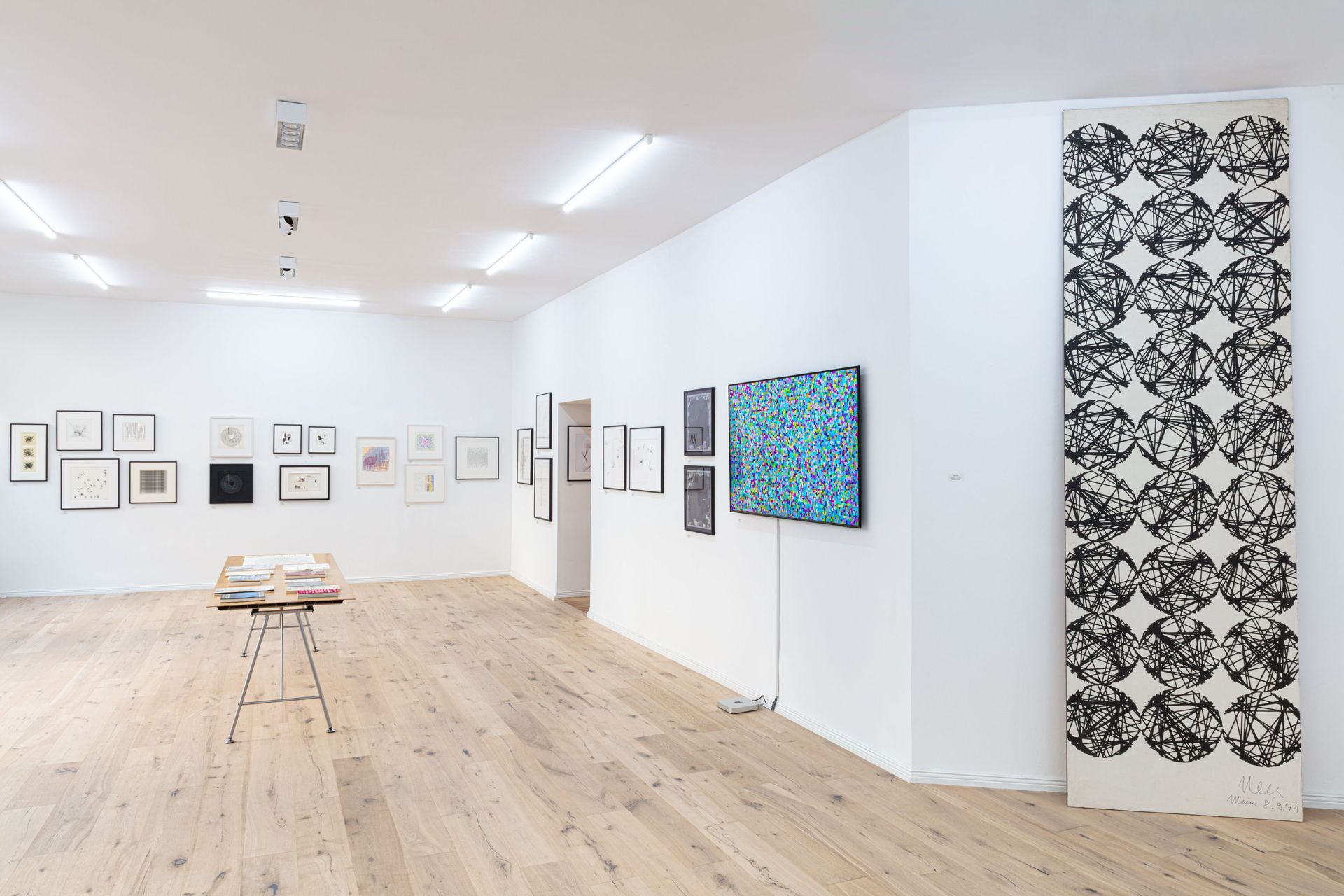
“1965 The Beginning – Georg Nees, Frieder Nake”, DAM Projects Berlin, installation view
This conversation was recorded on September 12th, 2025, during the opening of “1965 The Beginning — Georg Nees, Frieder Nake” at DAM Projects, Berlin. Transcript, translation, and editing: DAM and Alexander Scholz