
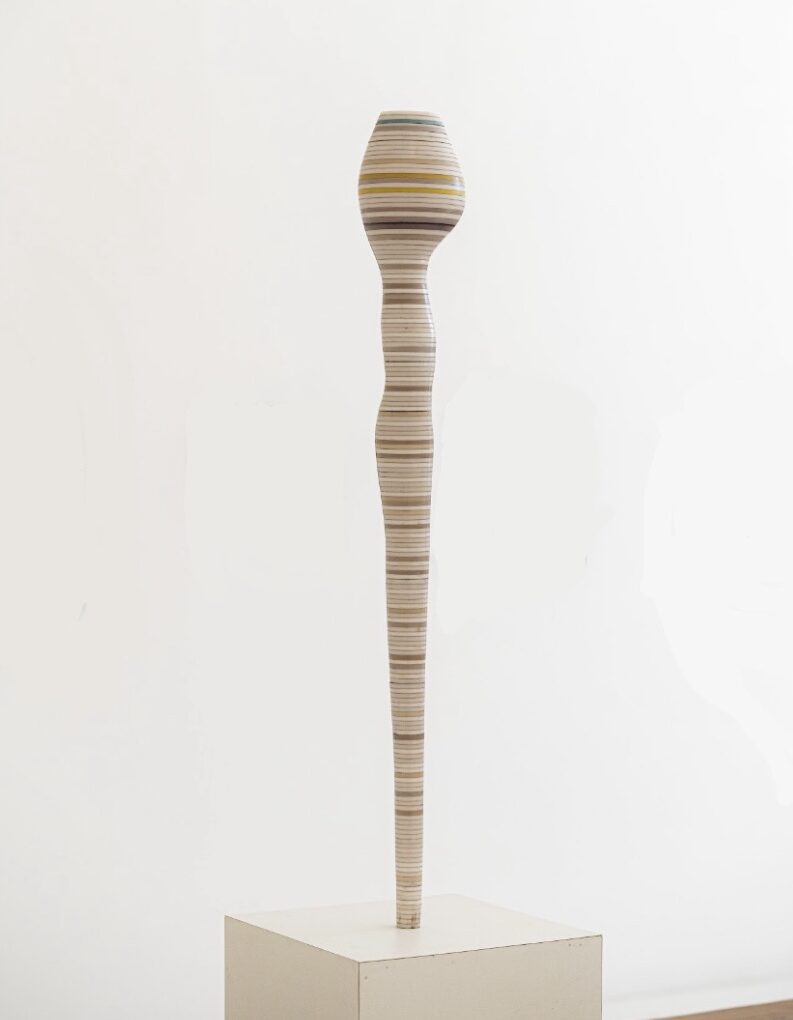
Quad I (1968)
Mallary created one of the world’s first digitally modeled sculptures, Quad 1, which was shown at the Cybernetic Serendity exhibit in London in 1968.
Together, Robert and his son, Michael Mallary, developed a Fortran computer program named TRAN2. From two contour profiles drawn by the artist, consisting of the X and Y coordinates, four points on ellipses were read off graph paper and then transferred onto punch cards. The cards were read by the IBM 1130 and plotter print outs on the IBM 1627 revealed the layers of the sculpture to be constructed. According to Michael Mallary: “After reading the data cards, TRAN2 calculated hundreds of connected contour points (i.e. points on the slice perimeter) for each horizontal slice.” What the program had calculated were the layers of the sculpture and “the plot for each layer was then glued to a sheet of plastic or wood and the slice perimeter was manually cut with a band saw. All of the slices were then stacked and bonded together.” The layers were then sanded and finished. Atop a wooden base, the resulting QUAD sculptures hint at a classical influence and the human form, while retaining a distinctive modern approach. Mallary had arrived at an early form of additive 3D printing
More works
Incremental Series (1970)
GRAF/D Series (1972)
Shape 3D Series (1979)
LNKD Series (1980)
Scribble Series (1980)
Spiro Series (1980)
Wire Series (1980)
Ribbon Series (1983)
Solar Series (1983)